
Nel corpo parti direttamente dal primo paragrafo:
Communicating that a product is “sustainable”, “green” or “environmentally friendly” is no longer just a marketing choice.
Environmental information is becoming increasingly regulated, and companies need to ensure that their claims are clear, specific and supported by verifiable evidence.
Directive (EU) 2024/825 strengthens consumer protection against potentially misleading environmental practices and introduces new rules that directly affect how companies communicate the environmental characteristics of products and services.
For companies, this means something very concrete: an environmental claim should not only be effective from a communication perspective. It must also be substantiated.
What are green claims?
A green claim is a statement through which a company explicitly or implicitly communicates an environmental characteristic or performance of a product, service or activity.
Expressions such as:
- “sustainable”
- “green”
- “eco-friendly”
- “biodegradable”
- “reduced environmental impact”
- “climate friendly”
can convey a specific message about a product’s environmental performance.
The more generic the claim, however, the greater the risk of communicating an environmental benefit that is difficult to substantiate.
From generic claims to specific claims
The direction of European regulation is increasingly clear: fewer generic statements and more specific, substantiated information.
Saying:
“This packaging is sustainable”
is very different from communicating a specific environmental characteristic of the packaging and providing the information needed to understand it.
The question should therefore not only be:
“Does this claim sound good?”
but also:
“What evidence do we have to support it?”
This changes the way marketing, sustainability, R&D and packaging development teams need to work together.
Which claims require particular attention?
There is no single formula that applies to every product.
The level of risk depends on the meaning of the claim, the context in which it is used and the information provided to consumers.
Particular attention should be paid to broad or absolute environmental statements and to messages that may suggest an overall environmental benefit without clearly explaining compared with what, according to which parameter and based on which evidence.
The same principle applies to symbols, images, colours, certifications and environmental labels: visual elements also contribute to the overall message perceived by consumers.
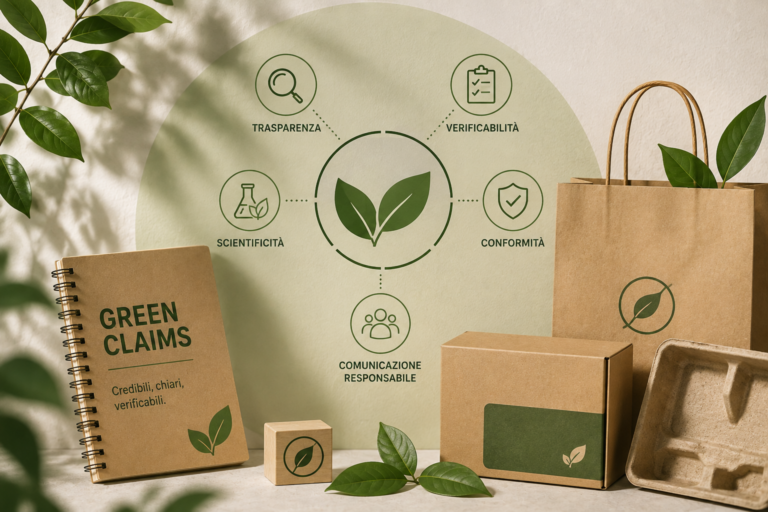
Verifiability: evidence comes before communication
A robust green claim should be developed after the technical assessment, not before it.
Depending on the claim, companies may need to assess:
- material composition;
- origin of raw materials;
- recycled content;
- recyclability;
- packaging performance;
- process data;
- available studies and technical documentation.
This does not mean that every claim requires the same type of evidence.
It means that the evidence should be appropriate to the statement being made.
Green claims and packaging
Packaging is one of the main channels through which environmental claims reach consumers.
Materials, labels, symbols, percentages, recyclability statements and environmental messages often coexist within a very limited space.
At the same time, packaging is also affected by the new framework introduced by the PPWR.
For this reason, packaging design and environmental communication should not be treated separately.
A technical choice regarding a material can determine which characteristics can legitimately be communicated, while a claim requested by marketing may require data and verification that should already be considered during packaging development.
A practical approach to more robust claims
Before communicating an environmental claim, companies can follow five basic steps:
1. Define exactly what you want to communicate.
What environmental characteristic of the product or packaging are you referring to?
2. Identify the available evidence.
Are there data, tests, technical documents or studies supporting the statement?
3. Define the scope of the claim.
Does it refer to the product, packaging, a component, the production process or the entire organisation?
4. Check that the wording does not overstate the evidence.
A specific result should not be turned into a much broader environmental statement.
5. Keep the supporting documentation.
The evidence behind the claim should be organised and easily traceable.
Sustainability should not be communicated less. It should be communicated better.
Companies do not need to stop communicating the environmental characteristics of their products.
Instead, businesses with robust data, innovative materials and genuinely improved processes can turn verifiability into an element of credibility and differentiation.
The challenge is to move from generic environmental language towards communication in which claims, technical evidence and the actual characteristics of the product tell the same story.
ARE YOUR GREEN CLAIMS SUPPORTED BY THE RIGHT EVIDENCE?
Bi-rex supports companies in assessing environmental claims, reviewing available evidence and developing communications consistent with the technical characteristics of materials and packaging.